María C. Uyarra: Blue Schools: The Pathway to Ocean Literacy
At the start of this century, US oceanography experts pinpointed a critical gap in the educational system: marine sciences were barely covered in the classrooms. What began in 2002 as an online conference to address this problem has now become a global movement that seeks to use the ocean culture to transform our relationship with the sea.

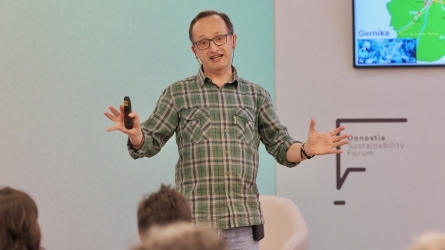
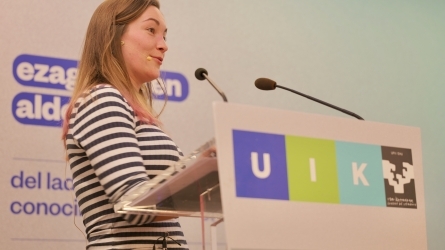
The biologist María C. Uyarra, a researcher at AZTI and coordinator of the Basque Blue Schools Network, explained this initiative – to include projects about the sea in the syllabus – at an event organised by the Donostia Sustainability Forum. It also drives citizen science initiatives, such as monitoring marine litter and recording urban art inspired by the ocean. The end goal is to create a society that makes informed decisions and acts responsibly to protect this vital ecosystem.
Our dependency on the ocean runs far deeper than many people think. It not only provides us with commodities and food – between 500 and 3,000 million people are estimated to directly depend on the sea for their survival – but it is also an essential climate regulator and a source of biodiversity which benefits, for example, pharmacology.
The value of the sea goes beyond monetary aspects as well. Surveys of recreational uses reveal that the ocean provides wellbeing, calm, happiness and relaxing, all vital factors for human health. For many of these reasons, 40% of the world’s population lives less than 100 km from the coast, resulting in a demographic pressure that threatens the health of those ecosystems.
21st-century challenges
The ocean is facing huge challenges: overfishing, plastic pollution, underwater noise, and even the growing presence of pharmacology products and drugs in the water. In addition, there is the impact of climate change, which is leading to the rise in sea level, acidification of the water and coral bleaching, to name a few.
Miren C. Uyarra warned that the complexity of those problems is similar to ‘solving a Rubik’s cube’. Greater ocean literacy is essential to be able to manage and tackle them. This idea involves understanding the mutual influence between the human being and the ocean and to act accordingly. As she explained, it is not enough to know that climate change exists; true ocean literacy leads us to make informed decisions and to behave responsibly with the marine resources.
Such knowledge dispels deep-rooted myths. For example, even though we usually talk about five oceans, there is only one connected global ocean scientifically speaking; that means that pollution caused at one point has ramifications around the world.
‘Blue Schools’ The classroom as a starting point
One of the problems found is that the school syllabus usually simplifies the marine reality. While different animal categories on land are studied, when it comes to the sea, the teaching is often collateral or skewed, with all fish being wrongly classified as omnivorous in text books.
The Blue School Network has been set up to reverse this. These institutions are driving learning by means of projects to do with the sea, where teachers and students to create a feeling of responsibility. There are currently national, regional and global networks. In the Basque Country, six educational centres are part of the local network. The projects are not limited to biology; they are cross-cutting and can include music, mathematics and languages.
Loving to protect
The final goal of those endeavours is to achieved informed societies that influence economic and political decisions. Measures such as banning micro-plastics in artificial grass or tethered bottle caps are necessary steps that often require top-down momentum to ensure sustainability.
As the researcher recalled by quoting Jacques Cousteau: ‘We only protect what we love, we only love what we understand’. Ocean culture is not only an unresolved matter; it is the compass that must guide our behaviour to guarantee that the ocean continues to be our greatest source of life and wellbeing.