The Environment and Underwater Sex: Navigating Sex as a Fish
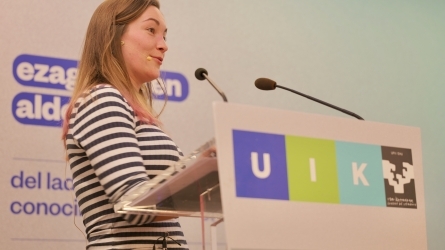
Ibon Cancio Uriarte’s mainly researches how pollution influences sexual differentiation of fish. During his lecture at DSF, he started by providing some easy-to-understand and detailed explanations of reproduction before he moved on the main theme. He pointed out that Charles Darwin is a god for coming up with the theory of evolution; males are costly from the point of view of the species and biological sex is diverse. Cancio made the audience laugh with the examples he used to explain these ideas, while setting the scene to understand more technical explanations.

Cancio is a researcher at the Plentzia Marine Station – where he mainly researches fish – and he calls his research team the palpati group. Because, as legend has it, a woman was once elected Pope by accident. The palpati, workers known as the feelers, were then tasked with confirming that the future Pope had testicles. The same happens at the marine station, in other words, they observe whether the male fish produce sperm or eggs. That is, if they are feminised.
In fact, some of the compounds discharged into the environment act as oestrogens and result in male feminisation. As Cancio explained, ‘this clearly shows that sex is easily altered in fish’. He pointed out that the source of those oestrogens includes female contraception. When women began to take the pill in the 1960s, hormones from their urine began to appear in the environment, and such hormones are very powerful. The conclusion is that male fish started to develop as females’.
However, he stressed that the pill is not the only source of oestrogens. For example, dimethoate has also been found in the environment: ‘This compound is an insecticide, similar to oestradiol’. Such sources are also found in soap and other everyday products.
Genetic market
Cancio’s laboratory thus analyses the gene expression of the fish affected by those compounds: ‘We look to see if the vitellogenin protein is expressed. Vitellogenin is produced in the liver of females and it then goes to the eggs. It increases the eggs to feed the embryo. Therefore, if this gene appears in males, it means that the compound in the environment has feminised them’, he explained.
Specifically, such studies have been conducted with mullet. ‘The mullet lives in muddy, cloudy waters. It does not eat much there, but it does in other places. It stands guard for us; it tells us what is happening in the environment’.
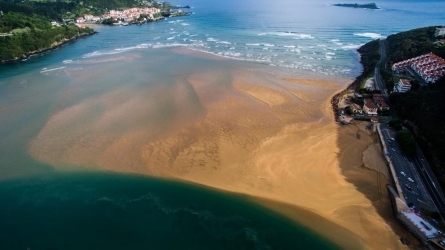
Studies conducted in the Gernika estuary since 2007 have shown the impact of infrastructures on the fish population. In fact, wastewater was discharged in the estuary, near to Gernika, up until 2021. However, the Lamiaran wastewater treatment plant came into service in 2021; the wastewater was sent there to be treated and then discharged at sea.
Cancio confirmed that males were seen to produce oocytes between 2008 and 2021. ‘The record was in 2021 when over half the males had eggs. Then none had any from 2022!’ Caring for the environment could therefore be seen to influence fish health directly.
They also studied whether the same was reflected in the genetic market and found that it is the ideal market to quantify it. Accordingly, they patented it. ‘These are the stories that we biologists like to tell; ones that are success stories’, Cancio pointed out.
He also explained that the genetic market was useful to measure the phase of development of the females. ‘This is very important as regards commercial fish species, as it determines the number that can be caught’. Thus, research is being conducted with tuna, such as the yellowfin fished in the Indian Ocean. The results so far are good and there soon may be another success story to tell.